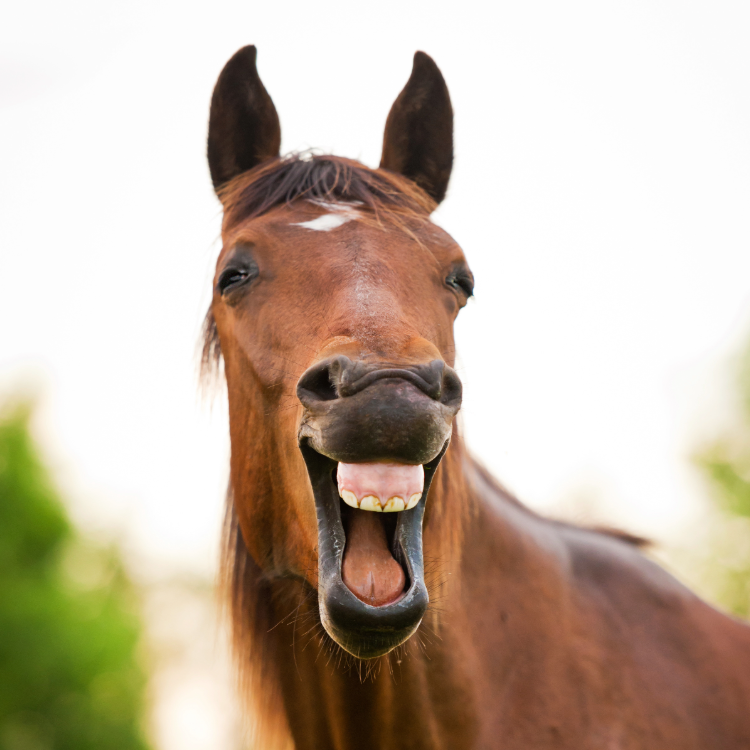
Horses may not have opposable thumbs or prehensile tails, but they do have amazingly agile noses!
I have a quarter horse named Xumie who has the most dexterous lips. Scientifically speaking, these precise movements are powered by the levator labii superioris muscle. One common use for equine lips is communication; they move to convey subtle emotions, moods, and reactions. Horses can say a lot with their lips, and even humans can learn to understand what they are expressing.
Prehensile Precision and Problem Solving
Communication, however, is not the only thing that fascinates me about Xumie’s lips. I am continually amazed by his ability to use them for obtaining food and seemingly entertaining himself. Dexterous lips are vital for selective foraging in the pasture and picking out finer foods like grains and pellets.
In the first two clips below, Xumie displays his impressive lip dexterity. He can reach right under the arena railing to tease tasty blades of green grass close enough to reach his teeth.
I was also astounded by his knack for getting cookies out of his treat ball. He quickly figured out how to rotate the puzzle ball upside down and shake it back and forth until the goodies dropped out. It took him less than two minutes to retrieve all four cookies—even though the toy was designed to keep him entertained for hours! Oh well.
Xumie reaching under the railing for grass]
[Xumie solving his treat ball puzzle]
The Arena Railing Mystery
In this final video, you can see Xumie rhythmically flapping his lips along the arena railing. Why on earth he does this, I have no clue—but it is certainly a lot of fun to watch!
[Xumie flapping his lips against the arena railing]
As a retired biologist, I cannot resist exploring the science behind why Xumie flaps his lips on the railing. While I initially thought it was just harmless, pleasurable self-entertainment, it may actually be a form of sensory exploration.
Many equestrians are familiar with the Flehmen response, where horses curl back their upper lip to draw scents into the vomeronasal organ to analyze environmental pheromones. But Xumie is not doing that here. Is he investigating scents left behind by other horses? Is he gathering chemical information rather than just amusing himself? It really looks like he is simply having fun—especially since he performs this routine right in front of me!
Another possibility suggested in equine behavior research is comfort-seeking or self-soothing. While that could play a role, I suspect he is primarily looking for my attention. Studies suggest horses often use repetitive muzzle movements to solicit social interaction and bond over a familiar person’s scent.
A Herd of Two
I am always touched that my horse actively seeks out my company. Sometimes, when I turn Xumie out into the arena, he doesn’t take off running, bucking, or rolling in the sand. Instead, he simply stands quietly by the gate, waiting for me. As soon as I join him, we walk together, and it becomes crystal clear that companionship was all he really wanted: to stroll side by side and share time together.
Even so, the curious scientist in me still wonders: what do you think he is trying to achieve when he flaps his lips along that railing?
Do your young readers love discovering the curious ways animals explore their world?
Nurture their sense of wonder with the Curtis Curly-tail Book Series! Journey alongside Curtis the lizard on fun, science-filled adventures that celebrate wildlife curiosity, animal communication, and habitat conservation.